
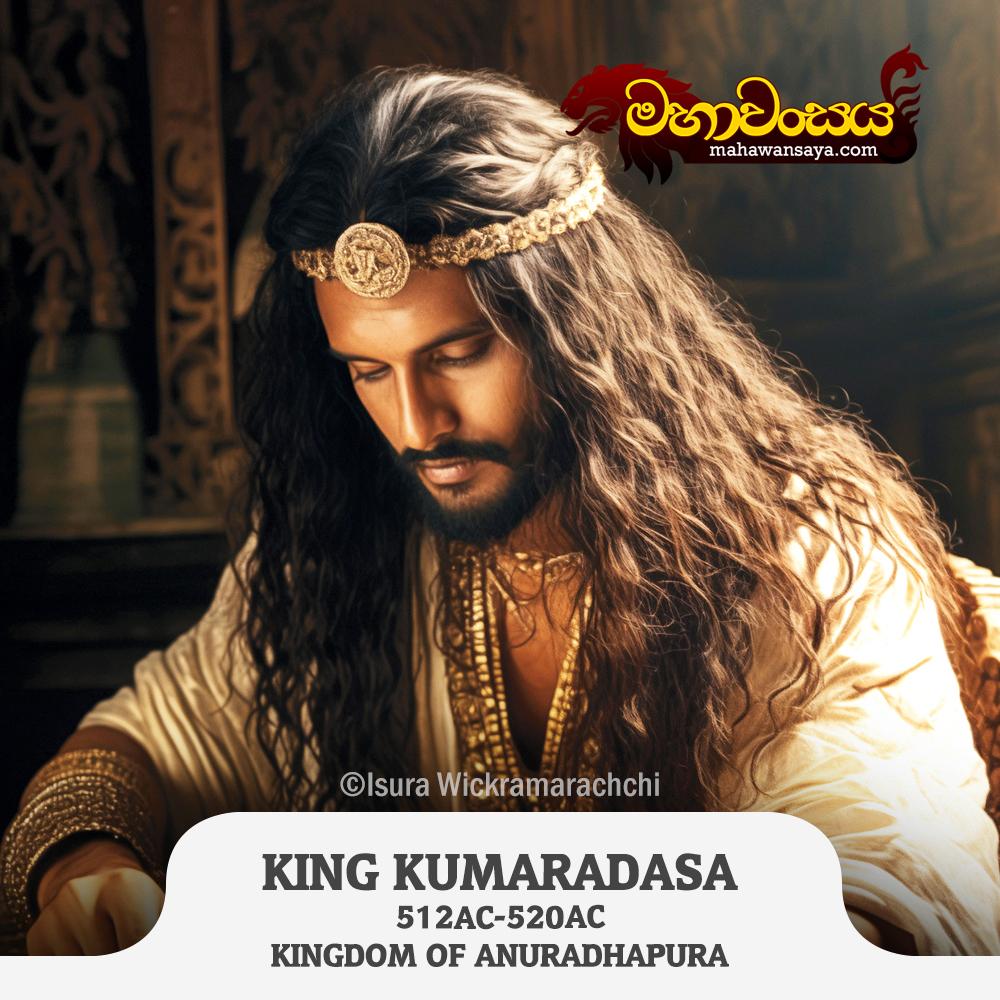
After King Mugalan, the throne was ascended by Prince Dhatusena. He was the son of King Mugalan. The chronicles describe this king as very powerful, with a form likened to that of a deity. In the Nagirikanda inscription, he is referred to as “Mahakumarathasa Raja Apaya.” In the Rajavaliya, he is called Kumaradasa. The name “Kumaradasa,” which means “servant of the prince,” does not seemfit a king; however, it is confirmed by the aforementioned inscription that it was applied to him. There are no special incidents recorded during his reign. It is only mentioned that he carried out acts of merit, such as organizing Dharma assemblies and conducting the purification of the Buddhist order.
The Pujavaliya and Rajavaliya also mention that the king was friends with the poet Kalidasa of Dambadiva and that he was cremated on a pyre after his death. The author of Perakumba Siri, writing during the Kotte period, narrates an elaborate story that the king built eighteen temples and eighteen tanks, among other constructions. However, the irrigation works and tanks attributed to him actually belong to King Dhatusena.
Although the Sanskrit epic “Janakiharana” has been ascribed to this king, there is no clear evidence to support this. Therefore, while there is no doubt that the work was composed by a Sinhalese royal poet, it cannot be conclusively attributed to King Kumaradasa.
During King Dhatusena’s reign, there were significant commercial connections with China and Greece. It is recorded that a Greek trader named Sopter visited Sri Lanka, saw the king, and gave him cash. This demonstrates the existence of foreign trade relations. There are no records of specific economic or agricultural development measures undertaken by the king, although the Nagiri Kanda inscription reveals that he constructed eight tanks for the Bamunugiri temple. These tanks were Mahagariya, Chugariya, Kabuva, Katavanaka, Pulasara, Thawa, Nilasa, Gaja, and Pada. The inscription shows that these tanks were built using stonework (kenavi). This suggests that the king likely constructed additional tanks not mentioned in the chronicles. King Dhatusena’s reign lasted nine years.