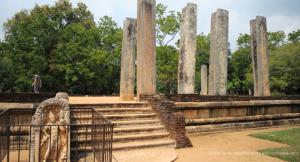
King Mahinda IIHouse of Lambakarna II | Anuradhapura - (778 - 797)
<p data-end="686" data-start="0">
The <strong data-end="30" data-start="4">seventh King Aggabodhi</strong> had a son named <strong data-end="58" data-start="47">Mahinda</strong>. He acted as <strong data-end="84" data-start="72">sub-king</strong>, but since he died prematurely, the position of sub-king remained <strong data-end="161" data-start="151">vacant</strong>. Traditionally, this meant that there was <strong data-end="259" data-start="204">no member of the royal family to inherit the throne</strong>. However, there was a <strong data-end="307" data-start="282">heir to fill that gap</strong>. He was <strong data-end="334" data-start="316">Prince Mihindu</strong>, the son of <strong data-end="367" data-start="347">Salamevan Aggabo</strong>, or the sixth King Aggabodhi. During this time, the seventh King Aggabodhi <strong data-end="501" data-start="443">called him, appointed him to the position of commander</strong>, and entrusted him with the <strong data-end="563" data-start="530">administration of the kingdom</strong>. However, he <strong data-end="608" data-start="577">did not accept the position</strong>. After King Aggabodhi, the throne was <strong data-end="683" data-start="647">succeeded by this Prince Mahinda</strong>.</p>
<p data-end="1619" data-start="688">
The <strong data-end="705" data-start="692">Mahāvaṃsa</strong> states the following regarding this. The sixth King Aggabodhi asked astrologers to examine the <strong data-end="834" data-start="801">birth stars of Prince Mahinda</strong>. They declared the prince to be <strong data-end="895" data-start="867">suitable for the kingdom</strong>. The king instructed them to <strong data-end="977" data-start="925">record this secretly and not reveal it to anyone</strong>, and he <strong data-end="1024" data-start="986">safely raised the prince in hiding</strong>. When the prince came of age, he was <strong data-end="1099" data-start="1062">granted the position of commander</strong>. During the <strong data-end="1169" data-start="1112">conflict between the sixth and seventh King Aggabodhi</strong>, the <strong data-end="1208" data-start="1175">administration of the kingdom</strong> was entrusted to Prince Mahinda. However, after his father’s death, he <strong data-end="1358" data-start="1280">refused to take the position of commander under the seventh King Aggabodhi</strong>. He acted as the <strong data-end="1413" data-start="1376">governor of Mahathiththa (Mannar)</strong> instead. Mahathiththa was a <strong data-end="1499" data-start="1442">key stronghold for commercial and military activities</strong> and needed to be <strong data-end="1535" data-start="1517">well-protected</strong>. Occasionally, it seems he also <strong data-end="1605" data-start="1568">administered the northern regions</strong> from there.</p>
<p data-end="1906" data-start="1621">
However, <strong data-end="1666" data-start="1630">Professor Senarath Paranavithana</strong> states that all this happened because <strong data-end="1769" data-start="1705">Prince Mahinda did not have a legitimate claim to the throne</strong>. The <strong data-end="1798" data-start="1775">second King Mahinda</strong> who later ascended the throne is the same prince, referred to in the chronicles as <strong data-end="1903" data-start="1882">Salamevan Mihindu</strong>.</p>
<p data-end="2702" data-start="1908">
The <strong data-end="1925" data-start="1912">Mahāvaṃsa</strong> details how Prince Mihindu ascended the throne. When the seventh King Aggabodhi died, Prince Mihindu was in the <strong data-end="2070" data-start="2038">Mahathiththa (Mannar) region</strong>, which was the <strong data-end="2121" data-start="2086">principal western port of Lanka</strong>. The official in charge of this port is recorded in inscriptions as <strong data-end="2221" data-start="2190">a person of great authority</strong>. As noted earlier, <strong data-end="2302" data-start="2241">attacks from southern Bharata to the Anuradhapura kingdom</strong> passed through this port. Likewise, foreign trade relations were conducted via this port. Therefore, the king’s trusted official had to <strong data-end="2480" data-start="2439">pay constant attention to this region</strong>. Prince Mahinda’s presence there was likely for this purpose. Meanwhile, the <strong data-end="2582" data-start="2558">fifth King Aggabodhi</strong> died. On learning this, Prince Mahinda immediately <strong data-end="2657" data-start="2634">went to the capital</strong>, fearing that a power vacuum might emerge.</p>
<p data-end="3172" data-start="2704">
He found that the <strong data-end="2744" data-start="2722">northern governors</strong> had <strong data-end="2790" data-start="2749">stopped payments and created disorder</strong>. Prince Mahinda sent a <strong data-end="2847" data-start="2814">military force to subdue them</strong>. Professor Paranavithana suggests that <strong data-end="2947" data-start="2887">no one feared that Prince Mahinda would seize the throne</strong>, since he had <strong data-end="2989" data-start="2962">no claim to the kingdom</strong>, and therefore he could <strong data-end="3051" data-start="3014">act with authority without threat</strong>. Consequently, he was <strong data-end="3120" data-start="3074">not an anointed son of Salamevan Aggabodhi</strong>, but there is <strong data-end="3169" data-start="3135">no evidence to claim otherwise</strong>.</p>
<p data-end="3808" data-start="3174">
At that time, the king’s final acts had <strong data-end="3258" data-start="3214">concluded according to ritual precedents</strong>. Prince Mahinda assumed that the <strong data-end="3355" data-start="3292">widowed queen, his mother, would act after the king’s death</strong>. Seeing the queen, he <strong data-end="3395" data-start="3378">comforted her</strong>, saying that she should <strong data-end="3496" data-start="3420">not grieve for the king but assume responsibility for the administration</strong>, and she remained silent. Her <strong data-end="3545" data-start="3527">inner thoughts</strong> are revealed later, as she <strong data-end="3613" data-start="3573">secretly proposed to kill the prince</strong> to place another queen in power. However, fortunately, Prince Mahinda <strong data-end="3770" data-start="3684">discovered this plan, spread the information to his supporters, and restrained her</strong>, securing the situation peacefully.</p>
<p data-end="4238" data-start="3810">
Professor Paranavithana interprets this differently. According to him, <strong data-end="3924" data-start="3881">Prince Mahinda tried to marry the queen</strong> to <strong data-end="3955" data-start="3928">legitimize his position</strong>. He sought to confirm his authority, but there is <strong data-end="4038" data-start="4006">no evidence in the Mahāvaṃsa</strong> to support this. Legally, Prince Mahinda <strong data-end="4109" data-start="4080">had a claim to the throne</strong>, and since it was <strong data-end="4166" data-start="4128">impossible to kill or displace him</strong>, the queen <strong data-end="4198" data-start="4178">submitted to him</strong>, as later described in the Mahāvaṃsa.</p>
<p data-end="4895" data-start="4240">
After ascending the throne, Prince Mahinda could not <strong data-end="4324" data-start="4293">maintain control peacefully</strong>. <strong data-end="4337" data-start="4326">Dappula</strong>, a powerful leader with no direct relation to the throne but influential in the southern region of Kala Wewa, <strong data-end="4467" data-start="4448">caused disorder</strong>. The Mahāvaṃsa notes that Dappula was a <strong data-end="4559" data-start="4508">servant of Salamevan Aggabodhi (the sixth king)</strong>. Prince Mahinda did <strong data-end="4606" data-start="4580">not immediately attack</strong>, as he had to <strong data-end="4642" data-start="4621">organize his army</strong> and proceed carefully to Sanggama, which corresponds to <strong data-end="4734" data-start="4699">present-day Kurunegala district</strong>, part of the <strong data-end="4775" data-start="4748">ancient southern region</strong>. Therefore, it is clear that the <strong data-end="4892" data-start="4809">initial challenge to Mahinda’s authority came from Dappula, the southern prince</strong>.</p>
<p data-end="5386" data-start="4897">
Prince Mahinda, acting as <strong data-end="4936" data-start="4923">commander</strong>, took the widowed queen and moved against the enemy, resulting in a <strong data-end="5021" data-start="5005">major battle</strong>. Dappula was defeated and retreated to <strong data-end="5089" data-start="5061">Achchiselaya (Valasgala)</strong>. Mahinda could not pursue him because the <strong data-end="5177" data-start="5132">northern governors had seized the capital</strong>, but he <strong data-end="5258" data-start="5186">returned to Anuradhapura, defeated the enemies, and secured the city</strong>. The northern governors occasionally <strong data-end="5327" data-start="5296">caused trouble for the king</strong>, sometimes instigated by the queen or Dappula’s faction.</p>
<p data-end="5917" data-start="5388">
Dappula later <strong data-end="5440" data-start="5402">regrouped and reorganized his army</strong>. During this period, <strong data-end="5491" data-start="5462">two loyalists from Rohana</strong> joined him. They <strong data-end="5566" data-start="5509">brought a large army at night and surrounded the city</strong>. Prince Mahinda, with careful planning and consultation with his counselors, <strong data-end="5674" data-start="5644">attacked and defeated them</strong>, capturing the two loyalists without killing them. In this way, the king <strong data-end="5812" data-start="5748">eliminated all threats from the eastern and northern regions</strong>, protecting the queen and the child heir. After the child was born, the queen’s <strong data-end="5914" data-start="5893">resistance ceased</strong>.</p>
<p data-end="6461" data-start="5919">
Prince Mahinda had to face <strong data-end="5969" data-start="5946">numerous challenges</strong> during his early reign. The Mahāvaṃsa notes that the <strong data-end="6077" data-start="6023">queen, his minor mother, had initially opposed him</strong>, but he <strong data-end="6134" data-start="6086">handled all threats skillfully and patiently</strong>, eventually securing her submission without bloodshed. This indicates that <strong data-end="6272" data-start="6210">Prince Mahinda’s strategies and intentions were successful</strong>. After granting the <strong data-end="6336" data-start="6293">position of sub-king to the queen’s son</strong>, there were still <strong data-end="6392" data-start="6355">troubles from the southern region</strong>, where two <strong data-end="6458" data-start="6404">regional governors feared losing their inheritance</strong>.</p>
<p data-end="7252" data-start="6463">
Dappula, after being defeated in battle, <strong data-end="6550" data-start="6504">refused to accept his defeat several times</strong>. Two regional governors from the eastern region also <strong data-end="6623" data-start="6604">submitted again</strong>. The Mahāvaṃsa notes that these individuals were <strong data-end="6696" data-start="6673">brothers of Dappula</strong>, and therefore sons of <strong data-end="6757" data-start="6720">the sister of Salamevan Aggabodhi</strong>. Three brothers <strong data-end="6803" data-start="6774">entered into an agreement</strong> and established <strong data-end="6853" data-start="6820">forts near the Mahaweli River</strong>. This agreement may have been related to <strong data-end="6927" data-start="6895">the succession to the throne</strong>. The king secured the city and established a fort in <strong data-end="6998" data-start="6981">Mahummaragama</strong>. A battle took place in <strong data-end="7035" data-start="7023">Kovilara</strong>, the exact location of which is unknown today. During this battle, the two eastern brothers died, and Dappula fled to Rohana. Through all these conflicts, King Mahinda <strong data-end="7249" data-start="7204">eliminated all enemies across the kingdom</strong>.</p>
<p data-end="7973" data-start="7254">
Dappula continued to <strong data-end="7308" data-start="7275">attempt rebellion from Rohana</strong>. He reorganized the army without misleading the local population. Knowing this, the king realized that such rebellion <strong data-end="7467" data-start="7427">would harm the kingdom’s development</strong> and <strong data-end="7494" data-start="7472">oppress the people</strong>. Therefore, a <strong data-end="7540" data-start="7509">royal assembly was convened</strong>, attended by <strong data-end="7608" data-start="7554">monks, high officials, legal scholars, and experts</strong>, at <strong data-end="7626" data-start="7613">Thūparāma</strong>. The king <strong data-end="7673" data-start="7637">explained the necessary measures</strong>, and all agreed. King Mahinda <strong data-end="7757" data-start="7704">entrusted the kingdom to the monks and the people</strong> and <strong data-end="7788" data-start="7762">led his army to Rohana</strong>, reaching <strong data-end="7814" data-start="7799">Maraparvata</strong>, corresponding to <strong data-end="7884" data-start="7833">present-day Maragalkanda in Monaragala district</strong>. On the way, the Rohana people saw the destruction he caused and <strong data-end="7970" data-start="7950">submitted to him</strong>.</p>
<p data-end="8825" data-start="7975">
Despite Dappula being a formidable enemy, King Mahinda <strong data-end="8063" data-start="8030">did not intend to destroy him</strong>, considering the future carefully. However, he deemed it necessary to <strong data-end="8159" data-start="8134">punish the wrongdoers</strong>. The <strong data-end="8225" data-start="8165">northern boundary of the kingdom was extended to Gal Oya</strong> for this purpose. Traditionally, the <strong data-end="8322" data-start="8263">Mahaweli River marked the boundary of the Rohana region</strong>, but Mahinda established the boundary at <strong data-end="8375" data-start="8364">Gal Oya</strong>, punishing Dappula accordingly. The Mahāvaṃsa refers to this river as <strong data-end="8460" data-start="8446">Gālhaganga</strong>, though some manuscripts mention <strong data-end="8523" data-start="8494">Kanha Ganga (Black River)</strong>. In any case, the river <strong data-end="8588" data-start="8548">remained part of the Rohana boundary</strong>, and extending it to Gal Oya was <strong data-end="8650" data-start="8622">intended as a punishment</strong>. Historically, the <strong data-end="8708" data-start="8670">Gal Oya valley was a major granary</strong> for both Rohana and the kingdom. Wars during King Dutugemunu’s time were often conducted near this fertile region.</p>
<p data-end="9419" data-start="8827">
King Mahinda also <strong data-end="8896" data-start="8845">changed the administrative boundaries of Rohana</strong>, as confirmed by inscriptions. Three inscriptions from <strong data-end="8992" data-start="8952">Rajagala (present-day Ampara region)</strong> belong to his reign, according to Professor Senarath Paranavithana. One mentions <strong data-end="9140" data-start="9074">a ritual performed by official Veerankura at Ariththara Vihara</strong> under the orders of the official Sen. Ariththara Vihara was located on <strong data-end="9230" data-start="9212">Rajagala lands</strong>, identified as the <strong data-end="9297" data-start="9250">Girikumubhi Vihara built by King Lajjitissa</strong>. This site, used by many kings for religious offerings, was an <strong data-end="9416" data-start="9361">important ceremonial platform in the Gal Oya valley</strong>.</p>
<p data-end="10136" data-start="9421">
Thus, the <strong data-end="9454" data-start="9431">second King Mahinda</strong> eliminated all enemies across the island. After establishing peace, he <strong data-end="9558" data-start="9526">focused on religious matters</strong>. He had the <strong data-end="9586" data-start="9571">Dāma Vihara</strong>, <strong data-end="9619" data-start="9588">Tembilithota in Polonnaruwa</strong>, and <strong data-end="9653" data-start="9625">Abhayagiriya Mahālekhaka</strong> repaired, <strong data-end="9727" data-start="9664">commissioned a Buddha statue in Ratna Prasada, Anuradhapura</strong>, and conducted a <strong data-end="9778" data-start="9745">ritual for the Hemasali monks</strong>. Cows and horses were distributed for cultivation, with horses given to Tamil people when cows were unavailable. Although battles occurred, <strong data-end="9969" data-start="9919">the kingdom experienced prosperous development</strong>. He repaired the <strong data-end="10007" data-start="9987">irrigation tanks</strong>, provided <strong data-end="10068" data-start="10018">ten thousand baskets of paddy as cattle fodder</strong>, and ensured <strong data-end="10115" data-start="10082">proper collection of revenues</strong> across the island.</p>
<p data-end="10467" data-is-last-node="" data-is-only-node="" data-start="10138">
The <strong data-end="10155" data-start="10142">Mahāvaṃsa</strong> praises King Mahinda’s <strong data-end="10215" data-start="10179">worthiness and ability to govern</strong>. Astrologers had declared him suitable from <strong data-end="10269" data-start="10260">birth</strong>, and his reign was marked by <strong data-end="10347" data-start="10299">tolerance, patience, and adherence to dharma</strong>. The account of his conflicts with Dappula demonstrates his <strong data-end="10431" data-start="10408">strategic foresight</strong>, and he ruled for <strong data-end="10466" data-start="10450">twenty years</strong>.</p>